Corian Kitchen Top: The Complete Guide

A Corian kitchen top is a solid surface countertop made from acrylic resin and mineral fillers. It’s non-porous, seamless, and repairable, making it a popular mid-range choice for kitchens. It costs less than most quartz but scratches more easily and needs care around heat.
What Is a Corian Kitchen Top?
Corian is DuPont’s brand of solid surface material, made from acrylic resin blended with natural minerals. A Corian kitchen top is fabricated from flat sheets, cut to size, and joined with color-matched adhesive so the seams are nearly invisible.
Because the material can be heated and shaped, fabricators can also build integrated sinks, coved backsplashes, and curved edges directly into the countertop — something few other materials can do.
Corian kitchen countertops have been used in homes since the 1960s, so the material has a long track record in kitchens, bathrooms, and commercial spaces alike.
Why Choose Corian for Kitchen Countertops

- Seamless look: Joints between sections are sanded down until they nearly disappear, so a corian kitchen counter can look like one continuous piece.
- Non-porous surface: Corian kitchen work tops don’t absorb liquids, so they resist staining from coffee, wine, and oil without sealing.
- Repairable: Light scratches and burns can often be sanded out on-site rather than requiring replacement.
- Design flexibility: Curved edges, integrated sinks, and custom shapes are possible because the material can be thermoformed.
- Mid-range cost: A corian kitchen top typically costs less than premium quartz or natural stone.
Corian Kitchen Top Price
Pricing for a corian kitchen top depends on the color, edge profile, sink type, and your kitchen’s layout. As a general range, installed corian kitchen tops typically fall between $45–$85 per square foot in the US, though premium colors and custom edges push that higher. VERIFY current pricing against real installer quotes before publishing — do not publish estimated figures as fact.
Get an accurate number by requesting a written quote for your specific kitchen rather than relying on a general average, since layout, demolition, and sink choice all change the final cost.
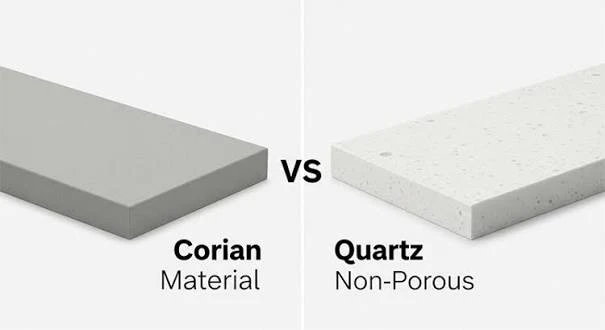
Corian Kitchen Top vs Quartz
This is one of the most common questions homeowners ask before choosing a corian kitchen top vs quartz. In short:
If you’re deciding between the two, our full comparison covers durability, cost, and care in detail: [INTERNAL LINK: Solid Surface vs Quartz Countertops — Complete Buyer’s Guide]
Kitchen Top Granite vs Corian
Granite is natural stone, quarried and cut into slabs, while Corian is a manufactured solid surface. The practical differences:
- Porosity: Granite is porous and needs periodic sealing. Corian is non-porous and never needs sealing.
- Pattern: Granite has natural, one-of-a-kind veining. Corian offers consistent, engineered colors and patterns.
- Seams: Granite seams are visible. Corian seams can be made nearly invisible.
- Repair: Corian can be sanded and repaired on-site. Granite chips are harder to fix seamlessly.
- Weight: Granite is heavier and may need extra cabinet support. Corian is lighter.
Homeowners who want a natural stone look often lean granite; those who want a seamless, low-maintenance surface often lean Corian.
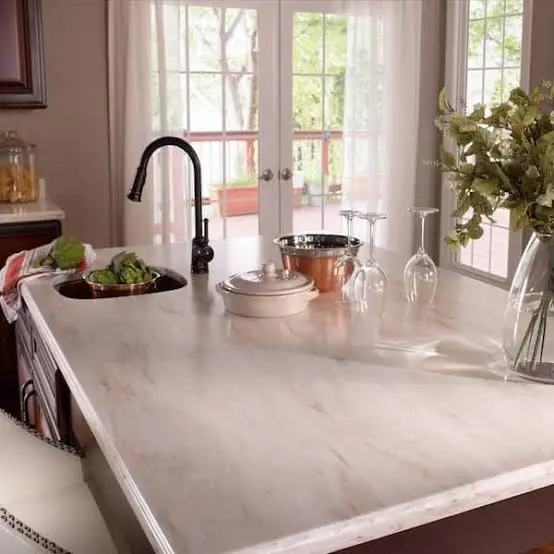
Corian Top Kitchen Island
A corian top kitchen island is a common application because the seamless finish works especially well on a statement piece. Since Corian can be joined invisibly, a large island top can look like a single slab even when it’s fabricated from multiple sheets. It also allows a waterfall edge (where the countertop wraps down the side of the island) without a visible seam at the corner — something that’s harder to achieve cleanly with granite or quartz.
Can You Use a Corian Countertop in a Different Kitchen?
This is a practical question worth answering directly: can I use a Corian countertop in a different kitchen? Technically, yes — Corian tops can be removed and reinstalled, since they’re mechanically fastened (not permanently bonded to cabinets in most installations). However, there are real limitations:
- Sizing: The piece was cut and templated for the original kitchen’s exact layout, so it will likely need to be re-cut, re-templated, or extended with new sections to fit a different space.
- Sink cutouts: If the sink and cooktop cutouts don’t match the new kitchen’s plumbing and appliance locations, the piece may not be reusable as-is.
- Seams and color matching: Adding new sections to an older piece can be difficult if the original color has been discontinued or has faded slightly with age.
- Professional handling: Because solid surface is fabricated with specific tools and adhesives, removal and reinstallation should be done by a qualified fabricator to avoid cracking the material.
In practice, most homeowners find it more cost-effective to have a fabricator assess the existing piece and advise whether reuse, resizing, or a fresh cut makes more sense for the new kitchen.
Corian Kitchen Top: Pros and Cons
Pros
- Seamless, custom-shaped design options
- Non-porous and easy to clean
- Repairable scratches and burns
- Integrated sinks possible
- Generally lower cost than premium quartz
Cons
- Scratches more easily than quartz or granite
- Can scorch under very hot cookware
- Fewer natural-stone-look patterns than quartz
Caring for a Corian Kitchen Countertop
- Clean daily with mild soap and water or a non-abrasive cleaner.
- Always use a trivet or hot pad — don’t place hot pots or pans directly on the surface.
- Avoid harsh chemicals like paint removers, oven cleaners, and drain cleaners.
- For light scratches, follow the manufacturer’s buffing guide; matte finishes can often be refreshed by hand, while glossy finishes usually need a professional.
FAQs
Is Corian good for kitchen countertops?
Yes. It’s non-porous, repairable, and allows a seamless, custom look, making it a solid mid-range choice for most kitchens.
How much does a corian kitchen top cost?
Installed pricing generally falls in a mid-range bracket compared to granite and premium quartz, but the exact cost depends on color, edge profile, and layout. Get a written quote for your kitchen.
Is Corian better than quartz for a kitchen?
Neither is universally better. Corian offers seamless joints, repairability, and integrated sinks. Quartz offers more scratch and heat resistance.
Can a Corian kitchen top be repaired if scratched?
Yes, in most cases. Light scratches and burns can often be sanded out on-site by a professional.
Can I move my Corian countertop to a new kitchen?
Often yes, but it typically needs re-templating, new cutouts, or resizing to fit the new space. Have a fabricator assess it first.
Get a Free Quote for Your Corian Kitchen Top
Considering Corian for your kitchen? Call: +15869268007 or request your free quote and we’ll connect you with a local fabricator who can price it for your space.