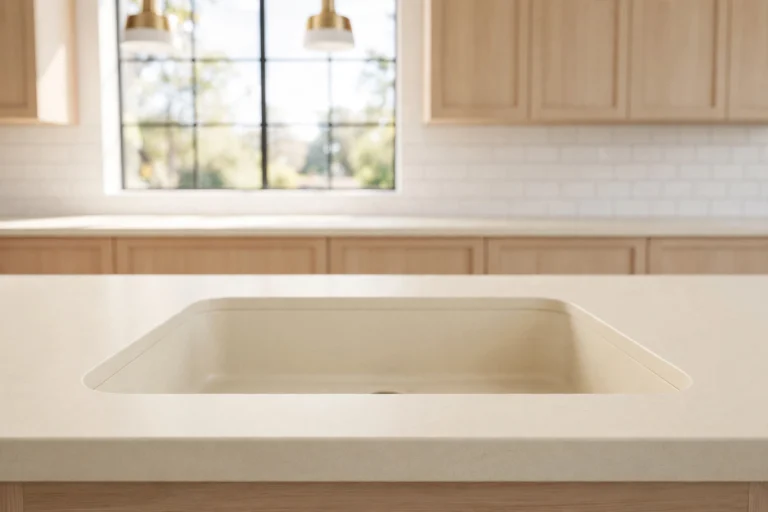
Corian Kitchen Countertops

If you’re weighing corian kitchen countertops against granite, quartz, or laminate, you’re not alone solid surface material has quietly become one of the most requested options for renovators who want a seamless, low-maintenance kitchen without the price tag of natural stone.
This guide breaks down everything you need to know: what it actually is, whether corian is good for kitchen countertops in your specific kitchen, real-world pricing, color options, and how to keep it looking new for decades.
What Is Corian Kitchen Countertops Material, Exactly?
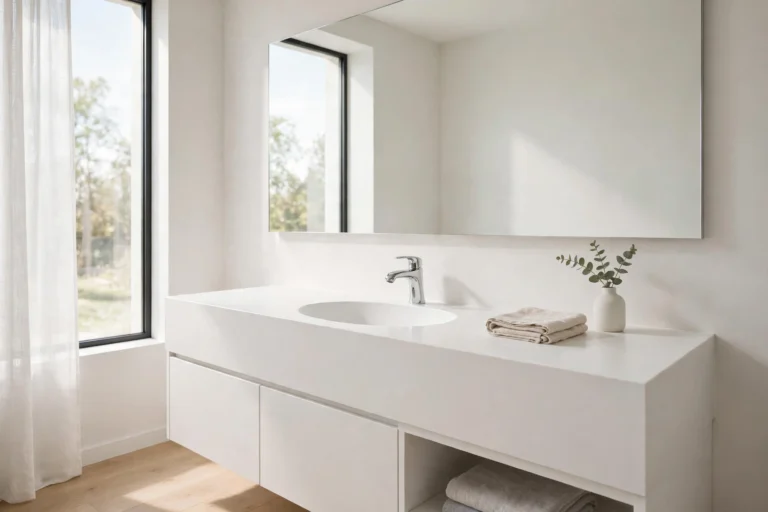
Corian is a solid surface material developed by DuPont, made from a blend of natural minerals and acrylic resin. Unlike laminate, which is a thin layer glued to a substrate, corian solid surface kitchen countertops are solid all the way through the color and pattern run the full thickness of the slab, not just the top layer.
This matters for two practical reasons. First, seams between sections can be fused and sanded until they’re virtually invisible, giving you a continuous, monolithic look across long runs of kitchen countertops corian installations. Second, because the material is non-porous, it doesn’t require sealing the way granite or marble does a meaningful advantage for busy kitchens.
One clarification worth making early: corian countertops for kitchen use should not be confused with “Corian Quartz,” a separate DuPont product line that blends quartz aggregate into the resin. Standard Corian is 100% acrylic solid surface; Corian Quartz behaves more like engineered quartz in hardness and heat resistance. If a supplier markets kitchen countertops near me corian quartz, ask specifically which product they mean the price and durability profile differ.
Is Corian Good for Kitchen Countertops?

yes, for the right kitchen. Is corian good for kitchen countertops depends on how you cook and what you prioritize.
Corian excels at:
- Seamless integration sinks and backsplashes can be thermoformed from the same material, eliminating grout lines and crevices where bacteria collect
- Repairability light scratches and burns can be sanded out at home, something no other countertop material offers
- Color consistency because it’s a manufactured material, every slab of a given color matches exactly, unlike natural stone’s variation
- Non-porous hygiene no sealing, no staining from wine, oil, or acidic foods
Where it falls short: it’s softer than quartz or granite, meaning it scratches more easily and can be damaged by direct high heat, like a pan straight off the stove.
Corian Kitchen Countertops Pros and Cons
Here’s the full corian kitchen countertops pros and cons breakdown side by side.
| Pros | Cons |
|---|---|
| Seamless, integrated sinks and backsplashes possible | Softer surface scratches and dents more easily than quartz or granite |
| Non-porous no sealing required, resists stains | Not fully heat-resistant; can scorch from hot pans |
| Scratches and minor burns can be sanded out | Lower resale “wow factor” than natural stone for some buyers |
| Wide range of solid and patterned colors | Can look less premium in ultra-high-end kitchen designs |
| Mid-range cost compared to stone | Edges can show wear faster in high-traffic prep zones |
| Warm to the touch, quieter than stone when placing dishes | Fewer dramatic veining options than quartz or marble |
Corian Kitchen Countertops Colors
One of the biggest draws of corian kitchen countertops colors is the sheer range DuPont offers dozens of solid, speckled, and stone-look finishes. A few popular directions:
- Neutral whites and creams: the most common choice for modern kitchen with corian countertops, pairing with almost any cabinet color
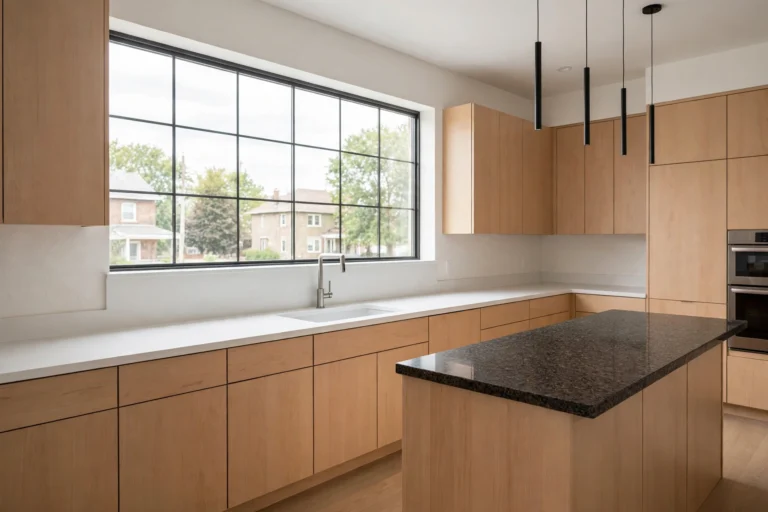
- Black corian kitchen countertops: a bold, high-contrast option often paired with light cabinetry for a two-tone modern look
- Kitchen blue corian countertops: less common but growing in popularity for statement islands, usually as an accent rather than a full-kitchen finish
- Stone-look patterns: designed to mimic granite or quartz visually while keeping Corian’s seamless, non-porous properties
Before choosing, request physical samples rather than relying on corian kitchen countertops images online — screen color rendering is notoriously unreliable for countertop materials, and the actual slab under your kitchen lighting can look noticeably different.
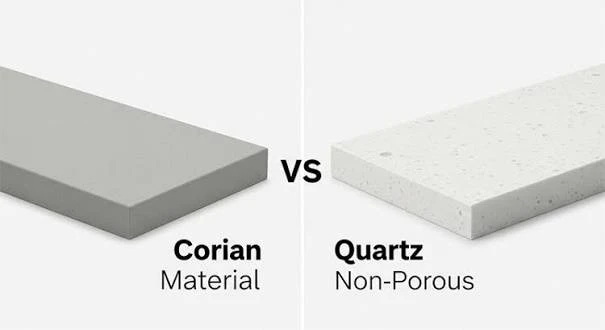
Quartz vs Corian Kitchen Countertops: How Do They Compare?
The quartz or corian kitchen countertops decision comes down to three factors:
- Hardness: quartz (engineered stone with resin binder) is harder and more scratch-resistant than solid surface Corian
- Repairability: Corian wins here; quartz cannot be sanded or repaired the way solid surface can
- Seams and integration: Corian allows invisible seams and integrated sinks; quartz seams are more visible and sinks are typically undermounted separately
For a quartz vs corian kitchen countertops decision in a high-use family kitchen with lots of chopping and hot pans, quartz often edges ahead on durability. For a design-forward kitchen prioritizing a seamless look, integrated sink, or lower cost, Corian is usually the better fit.
Corian Kitchen Countertops Cost: What to Budget
Kitchen countertops corian price typically runs $40–$65 per square foot installed, depending on color, edge profile, and region noticeably less than premium granite or quartz, which can run $70–$120+ per square foot. A standard 30-square-foot kitchen counter run in Corian generally lands between $1,200 and $2,000 installed, though integrated sinks and custom edge details push costs higher.
Factors that move the corian kitchen countertops cost up or down:
- Color and pattern complexity (solid colors cost less than stone-look patterns)
- Integrated sink and backsplash fabrication
- Edge profile (a simple eased edge is cheapest; bullnose or waterfall edges cost more)
- Regional labor rates for fabrication and installation
Where to Shop for Corian Kitchen Countertops
If you’re looking to shop deals on corian kitchen countertops, start with certified DuPont fabricators in your area rather than general home improvement retailers certified fabricators typically offer better warranty coverage and more accurate seam work.
Big-box options like home depot kitchen countertops corian installations exist through in-store design services, but pricing and color selection are usually more limited than working directly with a local fabricator.
When searching for corian kitchen countertops near me, request quotes from at least two or three fabricators, and confirm whether the quote includes template measurement, removal of old countertops, and sink cutout these are common add-on costs that can shift your final price significantly.
Corian Kitchen Countertops Reviews: What Homeowners Say
Across corian kitchen countertops reviews, the recurring themes are consistent: homeowners praise the seamless look and easy maintenance, while the most common complaint involves scratching near the sink and stove where daily wear concentrates.
Kitchens with dedicated cutting board habits and trivets for hot cookware report significantly better long-term results than kitchens where the countertop itself is used as a cutting or heat surface.
How to Clean and Care for Corian Kitchen Countertops
Proper care of corian kitchen countertops is simple and doesn’t require special products:
- Daily cleaning: warm water and mild dish soap on a soft cloth is sufficient for most spills
- Disinfecting: a diluted bleach solution (1 part bleach to 15 parts water) is safe for occasional disinfecting since the surface is non-porous
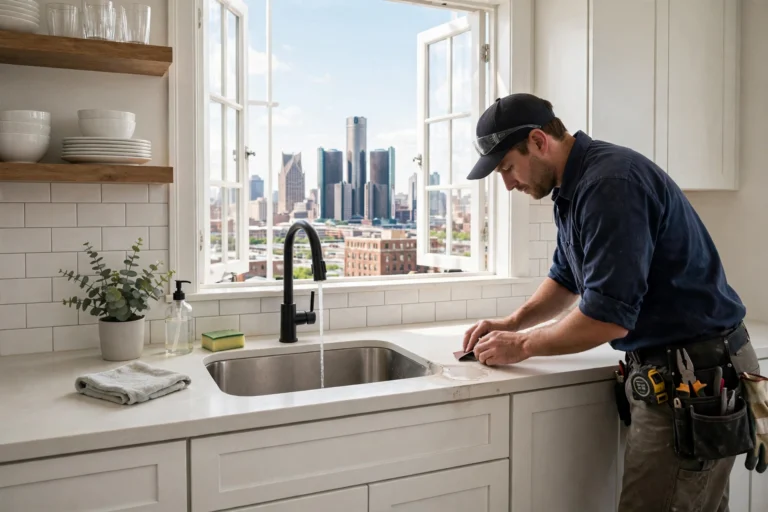
- Removing scratches: light scratches can be buffed out with a non-abrasive scrub pad and Corian-specific cleaner or a fine (600-grit) sandpaper for deeper marks
- Heat protection: always use trivets or hot pads; direct contact with pots and pans over roughly 212°F can cause discoloration or warping
- Avoiding damage: don’t use the countertop as a cutting surface, and avoid harsh solvents like paint thinner or oven cleaner
Following how to clean corian kitchen countertops guidance consistently is the single biggest factor in how the material looks after five or ten years of daily use.
Kitchen Cabinets and Corian Countertops: Design Pairing Tips
When pairing kitchen cabinets and corian countertops, contrast tends to photograph and live better than matching tones. Light cabinets with a darker Corian counter (or vice versa) create visual definition, while all-neutral palettes can read as flat under standard kitchen lighting. If you’re set on black corian kitchen countertops, pair with warm wood or white cabinetry to avoid an overly stark, clinical feel.
Frequently Asked Questions
What is Corian kitchen countertops material made of? Corian is a solid surface material made from a blend of natural minerals and acrylic resin, manufactured by DuPont. It’s solid throughout the slab, not just coated on top.
Is Corian good for kitchen countertops with heavy daily use? Yes, for typical home cooking. Corian handles daily wear well, but heavy chopping directly on the surface or repeated hot-pan contact will shorten its lifespan faster than in a lighter-use kitchen.
How much do Corian kitchen countertops cost per square foot? Most installations run $40–$65 per square foot installed, making Corian generally less expensive than granite or quartz.
Can you repair scratches on Corian kitchen countertops? Yes. Light scratches can be buffed out with a non-abrasive pad, and deeper marks can be sanded and re-polished a repair option not available with quartz or granite.
Is Corian or quartz better for kitchen countertops? Quartz is harder and more scratch-resistant; Corian offers seamless integration and repairability. The better choice depends on whether durability or a seamless design look matters more to you.
Where can I find Corian kitchen countertops near me? Search for DuPont-certified fabricators in your area first, then compare quotes against big-box retailers to check pricing and color availability.