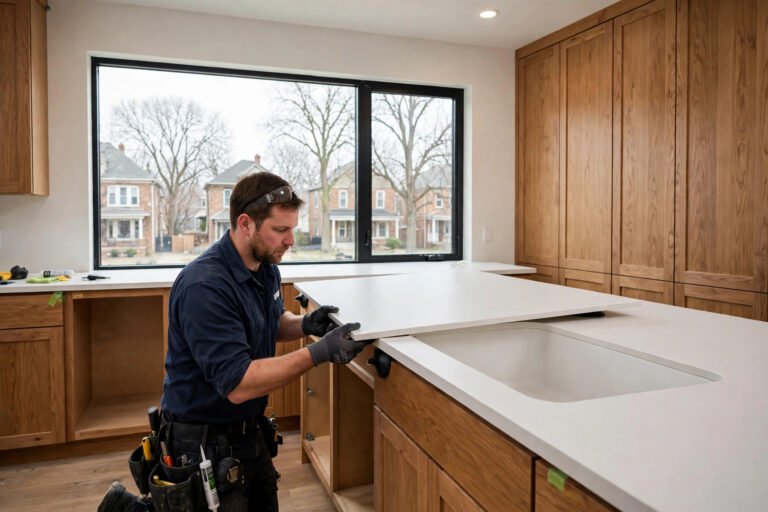
How to Remove Scratches from Corian Countertops — A Detroit Installer’s Actual Process
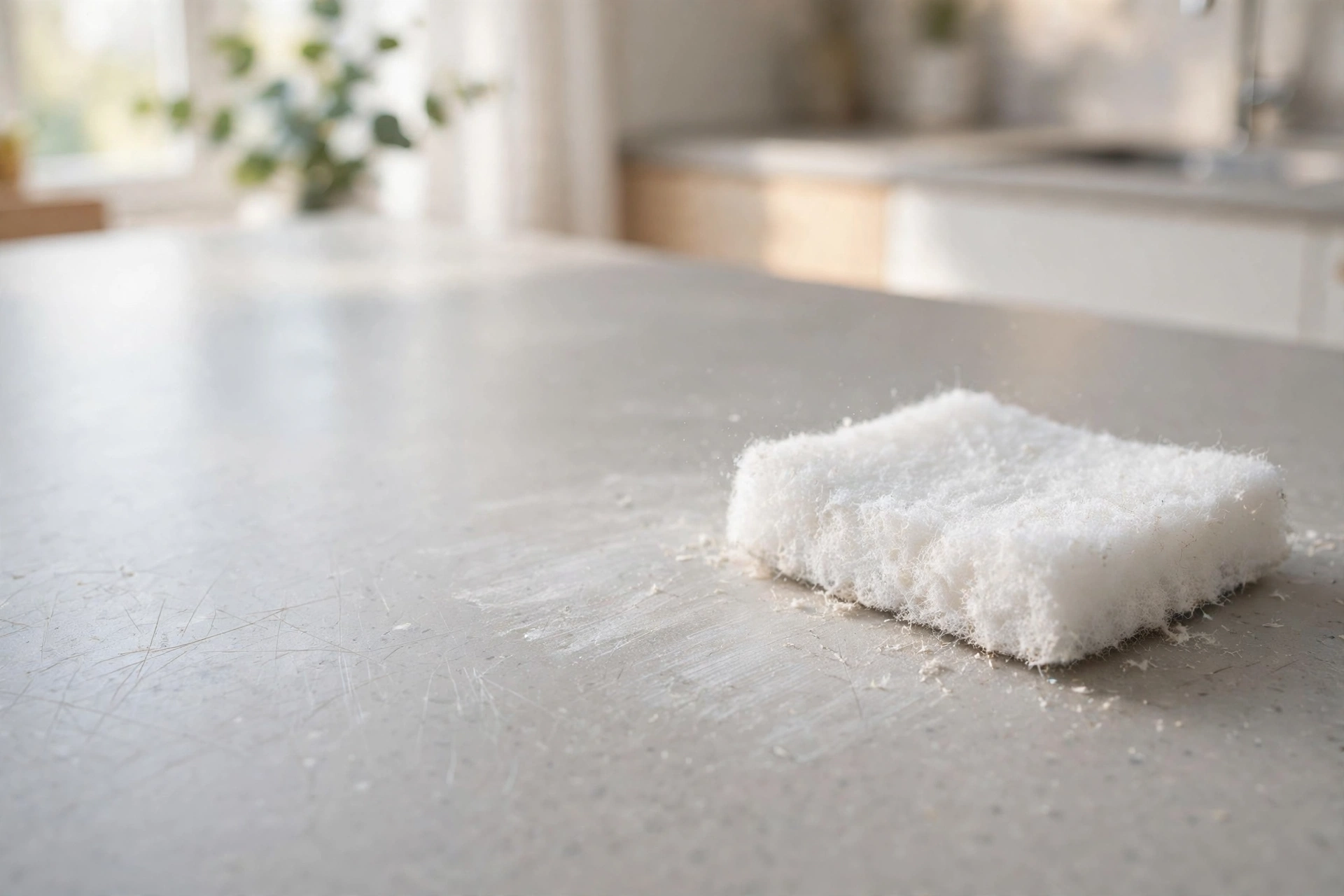
Scratches are the number one call I get about Corian tops — and honestly, they’re the number one thing you can fix yourself. I’ve installed Corian across the Detroit area for years, and the first thing I tell every homeowner is this: Corian is the same material all the way through. That’s acrylic resin and natural minerals, solid from top to bottom. So unlike laminate, where a scratch exposes a different color underneath, with Corian you’re just reshaping the surface a little. The scratch doesn’t go down to “the bad layer.” There is no bad layer.
That said — and this matters — there’s a right way and a wrong way to do it. I’ve seen more than one homeowner turn a three-inch scratch into a two-foot cloudy patch because they grabbed the wrong grit. So here’s exactly how I’d do it if it were my own kitchen, and exactly where I’d stop.
Figure out what kind of scratch you’re dealing with
Run your fingernail across it. This is the test.
- Your nail glides over it — it’s a surface scuff. Five minutes of work.
- Your nail catches slightly — a real scratch, but shallow. Totally fixable at home.
- Your nail catches hard, or the scratch is white and wide — that’s deep. You can improve it, but removing it completely is a job for someone with a random-orbit sander.
Why does this matter? Because the fix is different for each. And one of the biggest mistakes I see is someone attacking a surface scuff with sandpaper that’s way too aggressive for it, and ending up with a visibly dull spot that wasn’t there before.
What you’ll actually need
- Dish soap and warm water
- A clean, dry microfiber cloth
- A white Scotch-Brite pad (7448 is what Corian’s own documentation references; the plain white ones from the cleaning aisle work fine for matte finishes)
- A mild abrasive cleaner like Soft Scrub (the cream, not the gel)
- For deeper work: wet/dry sandpaper in P240, P400, and P600 — and ideally P1000 for dark colors
Don’t grab a green scrub pad. Those are far too aggressive for this. And don’t dry-sand. Wet sanding keeps the paper from clogging and keeps dust down.
Light scuffs and surface scratches (matte finish)
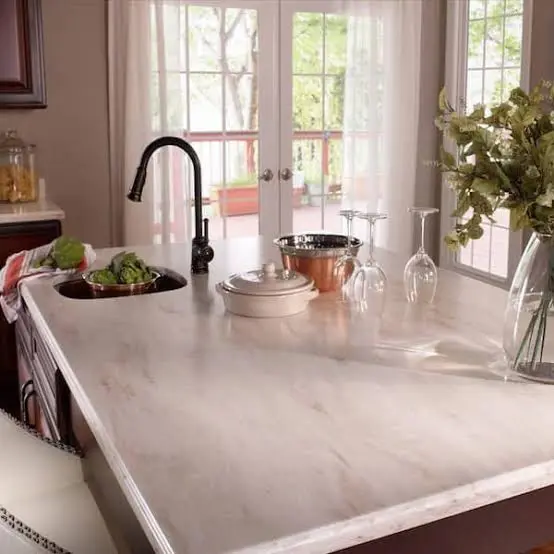
Most residential Corian installs are a matte or satin finish — the soft, non-shiny look. These are the most forgiving.
Wash the area with hot, soapy water first. Get every bit of grease and film off, then dry it. Then put a small dab of the abrasive cleaner on the damp white Scotch-Brite pad and rub the scuffed area in small circles. Light pressure. Check every thirty seconds by wiping clean with the damp cloth.
For the vast majority of everyday scuffs — the ones from sliding a plate, or where someone (we’ve all done it) set a ceramic mug down a little too hard — this takes about two minutes and the mark is gone. Rinse well, dry completely, done.
This works because you’re not really “removing” anything dramatic. You’re evening out the microscopic ridges around the scratch so light stops catching it. It’s refinishing, not repair.
Deeper scratches: the sandpaper sequence
When your fingernail catches, you need to go one step further. This is the part people mess up, so take it slow.
Wet the area and the sandpaper. Start with P240 — light, even pressure, sand along the scratch first, then work in small circles. Keep everything wet the whole time. Wipe it clean every minute or so to check your progress. You’re done with this step when the scratch is visibly shallower.
Now switch to P400, same routine. Then P600. Each finer grit removes the marks the coarser one left behind. That’s the whole logic — you’re trading one big mark for progressively smaller ones until the eye can’t see them.
Finish by buffing the whole area with the damp white Scotch-Brite pad in circles. Rinse, wipe dry, and look at it in daylight. In most cases, the scratch is simply gone.
Dark colors and semi-gloss finishes: proceed carefully
Here’s the honest part most guides skip. Dark Corian colors — your deep grays, blacks, browns — show every touch. The exact same sanding sequence that disappears on a light beige can leave a faint cloudy halo on a dark color, because sanding opens up micro-scratches that catch light differently.
If you have dark tops, do two things differently:
- Go one grit finer than you think you need — finish with P1000 instead of P600.
- Sand a slightly larger area than the scratch, feathering outward, so the transition is gradual instead of an abrupt edge.
And be realistic: on very dark gloss finishes, getting a perfect invisible fix at home is hard. Corian’s own guidance says deep scratches on semi-gloss and high-gloss finishes call for a pro with an orbital sander and a low-speed polisher. That’s not a sales pitch — it’s physics. We can refinish and repair your Corian countertops professionally if yours got past the DIY stage, and it’s usually a quick visit.
Choosing a color that’s more forgiving is worth thinking about if you’re shopping for a new top — mid-tones and patterned colors hide daily wear dramatically better than solid darks.
When to stop and call someone
I’ll be straight with you: there are three situations where you should put the sandpaper down.
Cracks. A hairline crack is not a scratch. Sanding a crack will open it up. Get it looked at before it spreads.
Burns. If someone set a scorching-hot pan directly on the top (Corian is heat-sensitive — always use trivets), the damage goes deeper than surface abrasion. Sometimes it’s repairable; sometimes that section needs attention. Don’t guess.
You’ve sanded for ten minutes and it’s not improving. Pushing harder or longer just thins the area and creates a low spot you’ll feel with your hand. Stop.
In any of these cases, call us at (833) 422-2167. Repair is one of the things we do every day, and it’s almost always cheaper than people expect. If you’re wondering about numbers, our cost guide lays out what different jobs typically run.
Keeping scratches away in the first place
- Cutting boards. Always. Corian scratches more easily than quartz or granite — that’s the tradeoff for being repairable. A $12 board saves a $40 service call.
- Lift, don’t slide. Pots, plates, the stand mixer — pick them up instead of dragging them.
- Felt pads under the toaster, coffee maker, and anything that sits in one spot and gets moved to clean under.
- Wipe up and dry after cleaning. Letting soapy water air-dry leaves a film that dulls the surface over time. Our full cleaning guide covers the routine that keeps a top looking new.
One more honest note: some wear is normal. Corian is softer than stone — that’s also why it can be refinished to look brand new after years, which stone can’t. Our pros and cons guide and the lifespan breakdown get into that tradeoff if you’re still deciding between materials.
FAQ
Will sanding my Corian void the warranty?
Minor cosmetic refinishing done carefully doesn’t affect the warranty in practice, but aggressive or botched DIY work can complicate a claim. When in doubt — especially on a top that’s still within its ~10-year residential warranty — call the installer first. If we did your installation, call us.
Can I use a repair kit from the hardware store?
For chips, yes — they’re mostly color-matched epoxy you press into the chip and level. For scratches, I’d skip them. A scratch needs the surface refinished, not filled, and filler in a scratch will read as a different shade in daylight.
How do I know if my scratch is too deep to fix myself?
The fingernail test is your best guide. If the nail catches hard, or you can see a lighter-colored groove more than a hairline wide, DIY will improve it but probably won’t erase it. That’s when a pro with proper sanding equipment is worth it.
Do scratches mean my Corian is wearing out?
No. Surface scratching is cosmetic and totally normal over years of use — Corian’s softness is what makes it repairable in the first place. A full professional refinish can make a 15-year-old top look new again, which is one of the reasons the material lasts as long as it does.
Your countertops, scratched up? Let’s get them looking new again.
Most scratch problems are a quick fix — and the ones that aren’t are a quick fix for us. Call (833) 422-2167, or reach us through our contact page.