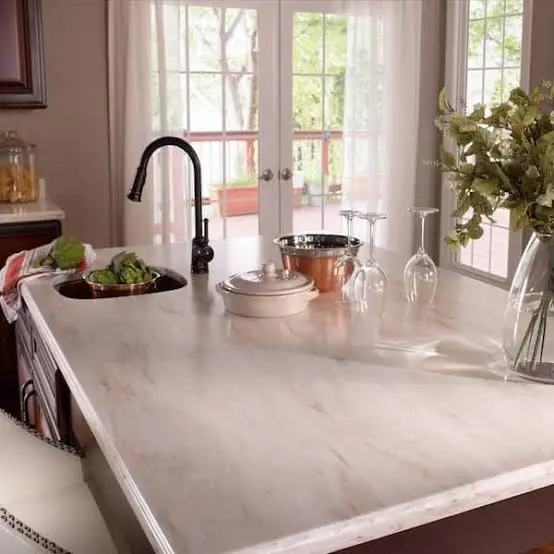
Corian vs Quartz Countertops: Which Should You Choose in 2026?
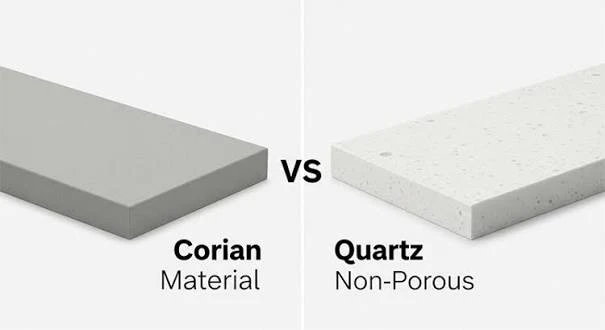
Choosing between Corian vs quartz is one of the most common decisions homeowners face when planning a kitchen or bathroom renovation, and it’s also one of the most confusing — both are engineered materials, both are marketed as low-maintenance, and both show up side by side in nearly every countertop showroom.
This guide breaks the decision down using the actual material science, pricing data, and long-term performance differences that matter, rather than generic pros-and-cons lists.
What Corian vs Quartz Actually Are
Despite being compared constantly, Corian vs quartz aren’t the same category of material.
Corian countertop is a brand name, originally developed by DuPont and introduced in 1967 as a solid-surface alternative to plastic laminate. It’s made from roughly one-third acrylic or polyester resin combined with natural minerals, and its color runs consistently through the entire thickness of the material — which is the property that makes it sandable and repairable.
Quartz countertops are engineered stone, made by binding roughly 90 to 94 percent crushed natural quartz crystal with polymer resin. Unlike Corian countertops, quartz is not a single brand — it’s a category that includes manufacturers like Caesarstone, MSI, Silestone, and Cambria (DuPont also makes its own quartz line, separate from Corian solid surface).
Understanding this distinction matters because it explains most of the performance differences below: Corian is a polymer-dominant material, while quartz is a mineral-dominant material — and that composition difference drives everything from hardness to repairability.
Hardness and Scratch Resistance
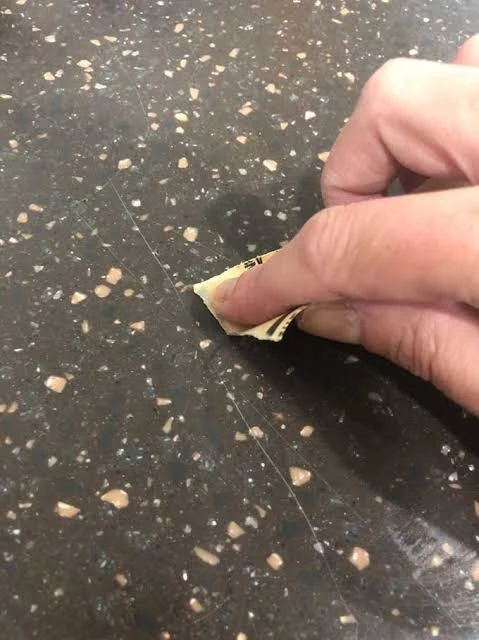
This is the single biggest technical difference between corian vs quartz the two materials, and it’s measured on the Mohs hardness scale, the standard geology scale for how resistant a material is to being scratched.
- Quartz rates approximately 7 out of 10 on the Mohs scale
- Corian rates approximately 2 to 4 out of 10
In practical terms, this means a knife dragged directly across a Corian countertops will leave a visible mark, while quartz shrugs off the same contact with little to no damage. This is the main reason quartz has largely displaced Corian as the premium countertop choice since the early 2000s — daily scratch resistance is one of the top factors homeowners cite when choosing a surface.
However, this is also where Corian’s biggest advantage comes in: because Corian’s color and composition are uniform all the way through, scratches can be sanded out with fine-grit sandpaper and a non-abrasive pad, typically restoring the surface in minutes. Quartz cannot be refinished this way — if it chips or cracks, the damage is generally permanent, and the affected section may need to be replaced entirely.
Heat Resistance
Neither material is fully heatproof, and this is a point where marketing claims often overstate real-world performance.
Corian can generally tolerate brief contact with cookware up to around 250°F without damage. Sustained contact or higher temperatures can cause white marks, scorching, or slight surface deformation. Quartz handles heat somewhat better than Corian but is still vulnerable — the resin binder in quartz can discolor or crack under a very hot pan straight off the stove.
The practical takeaway for both materials is the same: always use a trivet or hot pad. Neither surface should be treated as heatproof, regardless of what showroom staff may imply.
Cost Comparison
Pricing for both materials overlaps more than most comparison articles suggest, which is why “quartz is expensive, Corian is cheap” isn’t fully accurate anymore.
| Corian | Quartz | |
|---|---|---|
| Entry-level pricing | $26–$44/sq ft | $40–$65/sq ft |
| Mid-range pricing | $45–$80/sq ft | $65–$100/sq ft |
| Premium pricing | $60–$150/sq ft | $100–$200+/sq ft |
| Typical full kitchen | $2,200–$6,500 | $3,000–$8,000+ |
Entry-level quartz from mass-market brands can actually land close to mid-range Corian pricing, so the cost gap narrows significantly once you move past the cheapest tier of either material. Where Corian still holds a clear price advantage is at the premium end — high-end quartz slabs can run well past $150 per square foot, while Corian rarely exceeds $150 even at its highest tier.
Repairability: Corian’s Strongest Advantage
This is the factor most homeowners underestimate when comparing the two materials, and it’s where Corian genuinely outperforms quartz rather than just competing with it.
Because Corian is solid and consistent all the way through, a certified installer can sand out scratches, buff out dull spots, and even repair burns or minor cracks — often restoring the surface to like-new condition in a single visit. Quartz, by contrast, cannot be resurfaced. Once it’s chipped, cracked, or scratched, the only real fix is filling the damage (with a visible repair) or replacing the affected section.
For homeowners who value long-term ownership over decades rather than resale timing, this repairability can offset Corian’s lower scratch resistance — the damage happens more easily, but it’s also easier to fix.
Maintenance and Hygiene
Both materials are non-porous, which means neither requires sealing — a maintenance step still required for natural stone like granite. This puts both Corian and quartz ahead of granite for day-to-day upkeep.
Where they differ slightly: Corian’s surface can be more sensitive to harsh chemical cleaners and prolonged UV exposure, which can cause discoloration or yellowing over time, particularly in installations near large windows or in sunrooms. Quartz is generally more chemical-resistant, though certain quartz brands have specific cleaning restrictions to avoid dulling the resin finish. In both cases, mild soap and water remain the safest daily cleaning method.
Resale Value Considerations
This is a genuinely important factor that’s often glossed over: quartz currently carries stronger resale value in most real estate markets. Since the early 2000s, quartz has become the market expectation for updated kitchens, and many buyers and real estate agents view it as a standard modern upgrade, similar to stainless steel appliances. Corian, once considered a premium material in the 1980s and 90s, is now generally seen as a mid-range or budget-conscious choice.
This doesn’t mean Corian is a poor investment — it means the decision should be framed around how long you plan to stay in the home. For a forever home or a long-term renovation, Corian’s lower cost and repairability can make it the more practical choice. For a home being renovated with resale in mind within the next several years, quartz’s stronger buyer perception may justify the higher upfront cost.
Seams and Design Flexibility
One area where Corian has a clear, often underrated advantage is seam integration. Because Corian can be thermoformed and joined with color-matched adhesive, installers can create genuinely invisible seams — including sinks integrated directly into the countertop with no visible joint at all. Quartz seams, while much improved over older stone-seaming techniques, are still generally visible on close inspection, particularly on patterned slabs where the pattern doesn’t align perfectly across the seam.
For homeowners prioritizing a completely seamless, minimalist look — especially with integrated sinks or curved edges — Corian remains the stronger choice on pure design flexibility, even though quartz wins on raw durability.
Which Should You Choose?
There’s no universal right answer, but the decision generally comes down to three questions:
- How long will you own this kitchen? Long-term ownership favors Corian’s repairability; near-term resale favors quartz’s market perception.
- How much daily wear will the surface see? High-traffic kitchens with heavy cooking and cutting favor quartz’s scratch resistance; lower-traffic kitchens or bathrooms are well-suited to either.
- Do you want integrated sinks or curved, seamless design elements? Corian’s thermoforming capability gives it a real edge here that quartz can’t fully replicate.
Frequently Asked Questions
Is Corian cheaper than quartz? At the entry and mid-range levels, pricing overlaps significantly, with Corian typically running $26–$80 per square foot and quartz $40–$100 per square foot. Corian holds a clearer price advantage at the premium tier, where high-end quartz can exceed $200 per square foot.
Which is more durable, Corian or quartz? Quartz is significantly harder and more scratch-resistant, rating about 7 on the Mohs hardness scale compared to Corian’s 2 to 4. However, Corian’s damage is repairable through sanding, while quartz damage is generally permanent.
Does Corian scratch easily? Yes, relative to quartz — a knife or abrasive cleaner can leave visible marks on Corian. The advantage is that these scratches can typically be sanded out in minutes by a certified installer.
Which countertop adds more resale value, Corian or quartz? Quartz currently has stronger resale value in most markets, since it has become the expected standard for updated kitchens. Corian remains a solid mid-range choice for homeowners planning to stay long-term.
Can Corian or quartz handle hot pots and pans? Neither material is fully heat-resistant. Corian can be damaged by sustained contact above roughly 250°F, and quartz’s resin binder can also discolor or crack under very high heat. A trivet should always be used with both materials.
Get a Free Quote and Compare Your Options
Still deciding between Corian and quartz for your project? A certified installer can walk you through samples, pricing, and the right fit for your specific kitchen or bathroom layout. Request a free quote and get matched with a qualified professional — no pressure, no obligation.